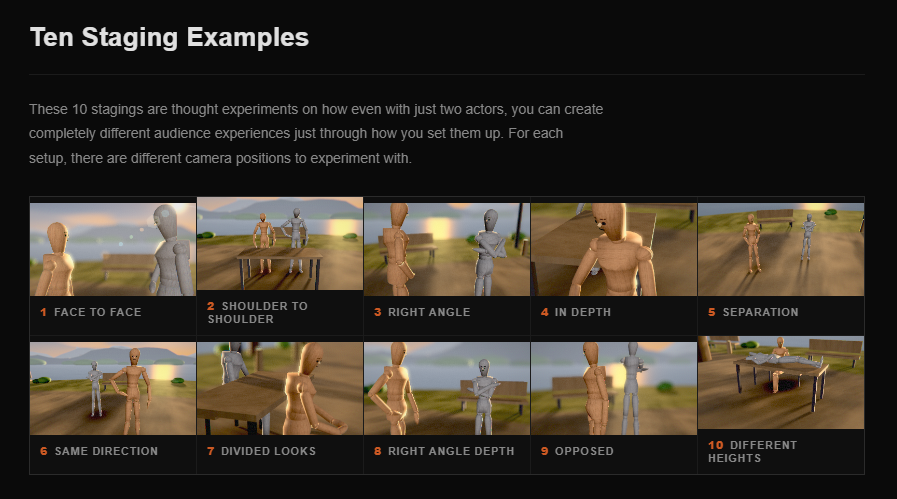
You might come across the words “blocking” and “staging” when figuring out how to prep for a shoot. In this sheet, we’re going to be looking at a method of staging dialogue, so it’s worth taking a beat to establish exactly what we’re talking about.
Staging vs Blocking
Staging is the broader concept - it's how you arrange everything in the frame: actors, camera, set pieces, lighting, props, all in relation to each other and to the story. Staging is about composition and meaning: where things are placed to communicate relationships, power dynamics, emotional distance, etc. “Mise-en-scène”, (pronounced meez-ahn-sen) which is another way of describing the same thing, but for those of you who want to sound more arty and French about it.
Blocking is more specifically about movement - the choreography of how actors (and sometimes the camera) move through the space during a scene. It's the plan for who walks where, when they sit, when they cross the room, when they turn away from someone. Blocking is usually worked out during rehearsal with the actors and director.
A useful way to think about it:
- Staging = the arrangement (a snapshot of the scene at any given moment)
- Blocking = the movement between those arrangements (how you get from one staging to the next)
Why It Matters
The more complexity you have in shot (normally the more characters that you have interacting with each other), the more blocking and staging becomes important. You’ll notice it when it’s done wrong because something will seem unintentionally jarring or confusing in your viewing experience (you’re not sure who is talking to who, or it feels like someone has just teleported across the room).
Without clear guidance, AI will flub blocking and staging, whilst also making creation accessible enough that people are more likely to create complex scenes that require planning.
The System
SO. Let’s cheat sheet it up, we're going to break these concepts down into a series of cheat sheet's starting with staging dialogue scenes. These sheets teach Steven Katz’ (Author of Film Directing Shot by Shot) letter based approach, adapted based on my own experience. The first one is Two Person Staging.