
The Decisive Moment
Visual composition is a hell of a topic to try and break down into one measly chunk of writing.
Put simply, my approach is something like this: What is the purpose of this image? Put in everything that achieves that purpose, and remove everything that doesn't.
That actually makes photographic composition much harder than traditional painting - without post production, you can't just remove things, so you have to hunt for what the French photographer Cartier Bresson called “the decisive moment”, the moment where the world is in the right place for what you want to capture.
Film has its own decisive moments, the whole reason we shoot multiple takes is because we're hunting them! They will often elude you if you don't know what you're looking for though.
Rules Without Theory
So this cheat sheet in design is a breakdown of the basic things you'll probably want to consider when consciously composing an image. Hopefully you'll find it both fun and useful, but as always I'll put in an anti-theory caveat. I really believe you can figure composition out yourself without knowing rules, as long as you're asking yourself the essential question “What is the purpose of this image?”
Your brain is already conditioned to interpret images. It knows that if you're looking down from the edge of a cliff, or inside the mouth of a lion, you're in danger. Present those images to an audience, and you know how most of them will react. And you know how they'll react to blue skies, a beach, and a hammock between two palm trees.
With this in mind, the only thing you need is to be mindful whenever you're creating an image or setting up a camera. And AI will steal that mindfulness from you in a heartbeat, so be careful.
What's Inside
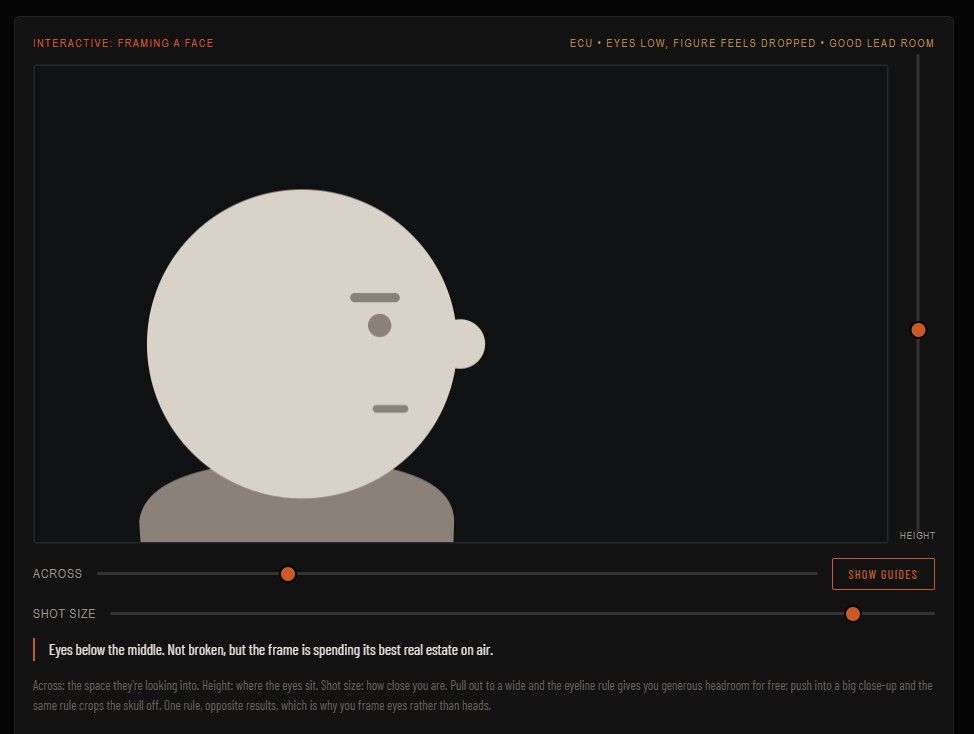
- The frame – What needs to be in the frame to tell the story?
- Visual weight – Learn about the six magnets that pull the eye and experiment with how they work.
- Balance – an interactive see-saw showing how mass and distance from centre keep a frame from tipping.
- Contrast – explore six oppositions (light/dark, large/small, warm/cool, and more) to see what's holding the frame together.
- Figure & ground – separating your subject from its background, and how little tone contrast you need once the ground goes soft.
- Lines & tension – why diagonals carry energy.
- Rhythm & pattern – play around with breaking the patterns and notice how this pulls your attention.
- Depth – drag the focal length and watch a wide lens exaggerate space while a long lens compresses it.
- Composing for movement – an interactive demo exploring space and movement combined with shot sizes.