
Whatever happens with AI, it’s difficult for me to envision a world where hand crafted animation doesn’t have a place.
As all the big studios are now using AI in some capacity or other, they’re obviously taking some heat for being anti-creativity. But let’s take Disney as an example, since back in the day, they were all about lovingly, hand crafted, 2D animation. OR WERE THEY?
LESSONS FROM DISNEY'S GOLDEN AGE
For example, they used rotoscoping (just filming a person and tracing round them) very early on – first in a short, Goddess of Spring, in 1934, and then in Snow White and the Seven Dwarves in 1937.
Rotoscoping is a “cheat”, AND it’s really noticeable, since a traditionally animated character will always move differently to a rotoscoped person. AI will also move differently to a hand animated character, and also make different decisions to an actor.
As they approached the films of my childhood (The Lion King, Aladdin, The Little Mermaid, etc), and therefore what I consider their golden age, they were outsourcing all but the most essential creative labour outside of the studio.
Outsourcing to a human isn’t the same as outsourcing to AI (at least the human gets income), but creatively it’s the exact same line of thought.
AND YET. Despite taking every single cheat that they could, Disney were always intensely focused on creativity. I strongly recommend Walt Stanchfield’s Drawn to Life books to get an understanding of just how focused they were on training and maintaining in-house talent. They are a collection of Stanchfield’s lectures and lessons for Disney artists, and are a goldmine of wisdom for any creative artist.
Whatever you think of their business practice then and now, the key idea of keeping strong creative voices in-house and outsourcing the heavy lifting makes sense at scale, and in an increasingly AI focused world.
And the lesson - which you can take or not depending on your own values - is that cheating is totally fine as long as the final product is rock solid, and the only way to get there is to be an incredible creative and the only way to be an incredible creative is to focus your energy by cheating on stuff that’s less important.
STRENGTHEN YOUR OWN ANIMATION MUSCLES
So ultimately whatever your take on AI is might be irrelevant inasmuch as whichever road you take, it should be focused on the pillars of creative storytelling.
So it’s with all that in mind that I recommend, nay I urge you to open up this cheat sheet on animating bouncing balls. This is the foundational exercise for every budding animator, and there’s a tonne to be learned from trying it yourself. If there wasn’t, everyone would just film balls bouncing and rotoscope them.
What's Inside
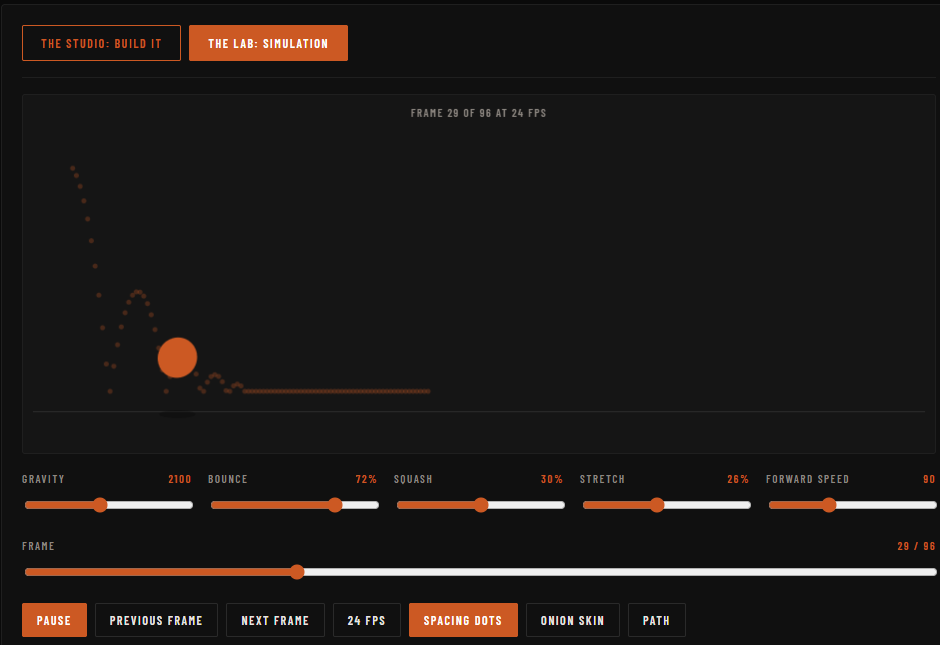
• Timing and spacing
• Squash and stretch
• Arcs and tangents
• Anticipation and follow through
• The workspace: Studio and Lab modes (Animation vs Simulation)