
Gaussian splatting is one of those wild, overly hyped, misunderstood corners of tech that influencers tell us will change film FOREVER, and then doesn't. That doesn't mean it won't, and it doesn't mean it isn't really powerful.
It's essentially a way of 3D scanning, but it's the best technology we currently have for digitally recreating a person, a prop or an environment as though you were actually there.
Polygons Have Limits
The other forms of scanning, photogrammetry and LiDAR, both of which are more common in film right now, give you polygonal meshes. Polygons are great for a lot of things, nearly all the rendered VFX you've ever seen uses them as a basis. But they have limits. They're pretty terrible at fine detail that breaks the silhouette, like hair and fur, and they need re-rendering to capture lighting and materials accurately.
Introducing...Little Trained Blobs of Colour!
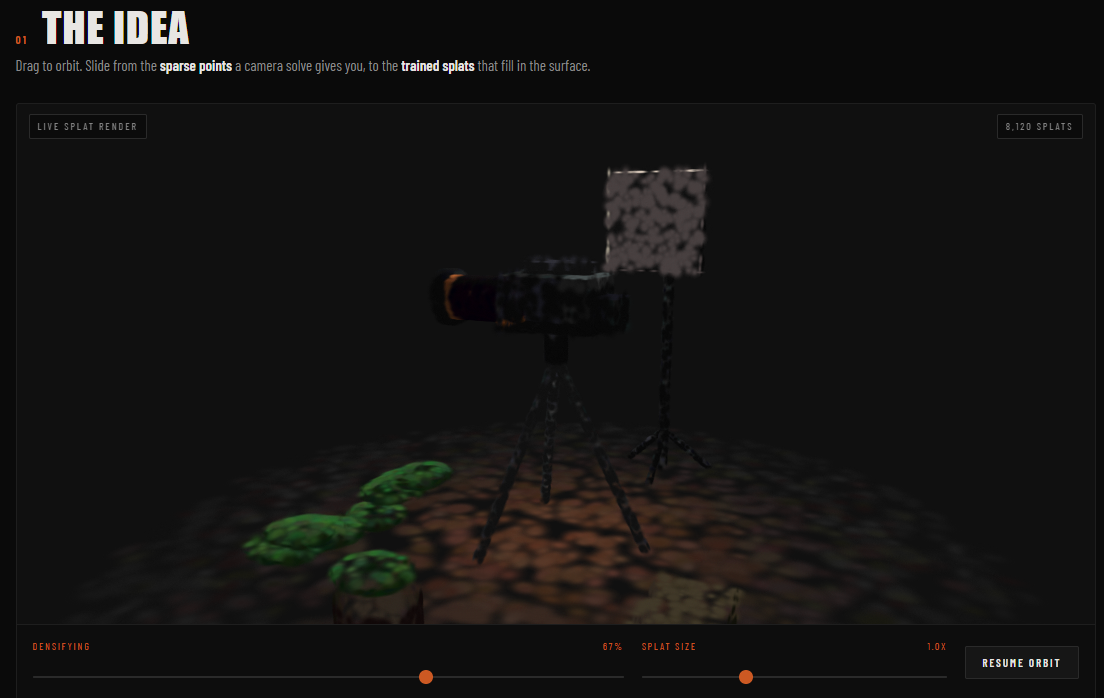
Gaussian splats aren't polygons at all, but little blobs of colour information. They store the colour of the object at that point, and also how it reacts to the light it's under at different angles: reflective, transparent, matte.
That makes them perfect for taking a 3D digital snapshot of a complex set or character, exactly as it was on the day of the shoot.
This allows you to create shots after shooting, and with the freedom of a digital camera and lens, so you can “film” without limits.
Get your splatty juice going on our cheat sheet here, and we’ll be going much deeper in our next live Follow Along workshop, focused on all things splat shaped!