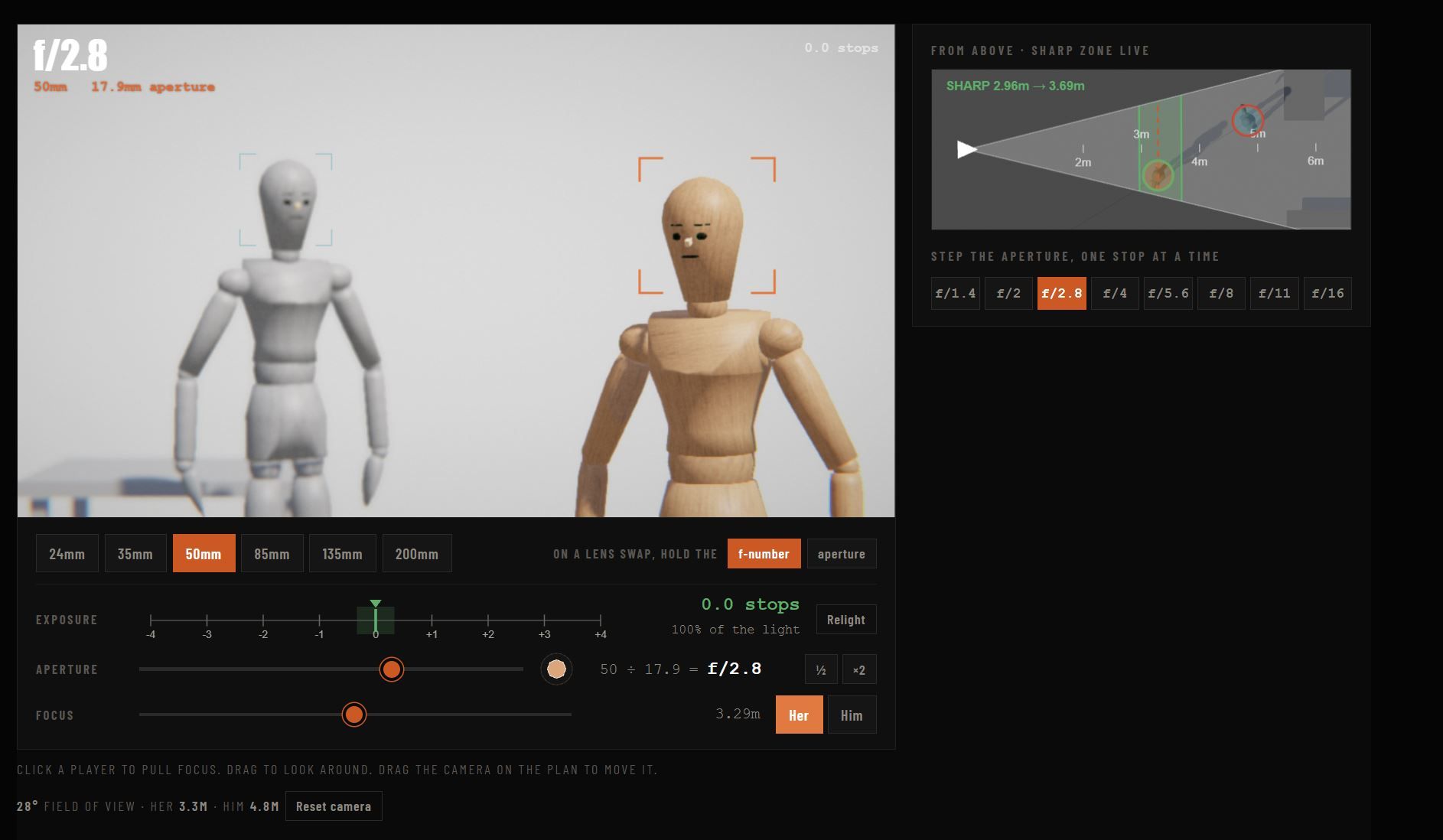
In your filmmaking journey, you’ll come across 4 different kinds of stops:
1. A “stop”
2. An “f-number/stop”
3. A “t-stop”
4. “ARGH STOP” (What you’ll scream half way through this if you’re not comfortable with the maths. But stick with it!)
A Stop
This is the doubling or halving of an amount of light. This originally had quite a literal meaning - it was based on “stopping” the amount of light entering the camera, which was done by closing the aperture. Then it morphed beyond apertures, into meaning brighter or darker regardless of the way of getting there.
If I want to sound filmy in front of a client, I’ll say something like “Should we go half a stop darker here?”, even though that just means pulling the exposure down a bit in the grade. The client normally rolls their eyes at my pretension.
An f-number/stop
An f-number is still related to the amount of light that comes in, but it’s a ratio. It’s the focal length of the lens divided by the aperture size.
So to keep the maths very basic, let’s say we have a 50mm lens (this means that the focal point of the lens is 50mm from the camera sensor), and the aperture to let the light in is 50mm across, what’s the f-number?
Focal length/aperture size = f-number
50/50 = 1
In reality, an f-number of 1 is quite rare, because it means a huge chunk of expensive lens glass (in this case, the lens glass itself would have to be bigger than 50mm, since only the centre of the lens, the “entrance pupil” is useful). Lower f-numbers (also called “faster” lenses) mean more cost, as a rule.
What if we want our 50mm lens to go one stop darker? That means half as bright, remember? Of course you do. Would you halve the f-number? NO. Lower f-numbers mean BRIGHTER.
Ok fine, would you double it? How would you do that? Halve the aperture diameter to 25mm? Let’s see
50mm lens/25mm aperture = f2
Smaller aperture, less light, higher f-number. The problem is that this isn’t one stop darker/half as bright. It’s TWO GODDAMN STOPS BRIGHTER. A quarter. 25%.
This is because halving the aperture doesn’t halve the amount of light entering the lens. The amount of light is the area of the circle. Which as you definitely remember from school, is πr²
50mm diameter means radius 25mm.
Π x 25 x 25 = 1,963 mm² area
Halving the diameter to 25mm gives you a 12.5mm radius
Π x 12.5 x 12.5 = 491 mm² area
Which is roughly 1 quarter, 25%, 2 stops darker.
SO. A stop brighter or darker is doubling the area of the aperture, which means fruitier maths, which means f-stops have irregular numbering.
E.g
The words f-stop and f-number are often used interchangeably, but f-stop really just means “a stop change achieved through the aperture.” So one stop darker from f/1 is f/1.4, so that’s one f-stop down.
We’ve been using a 50mm lens as an example, but because f-number is a ratio, the same f-number lets in the same amount of light on any lens.
So a 50mm lens at f/2 is a 25mm hole. A 200mm lens at f/2 is a 100mm hole. Both allow the same amount of light through. Yes, The 200mm lens has a hole 4× wider, but its focal length is also 4× longer. That means the light is spread over a proportionally larger area before reaching the sensor.
Which takes us to another really important side effect of changing the lens aperture - it changes your depth of field. That is to say the amount of your image that is in focus changes drastically based on how open or closed the lens is.
The focal point of the lens doesn’t change, but the cone of light entering the lens does. The smaller and tighter that cone is, the more of the image is in focus. A smaller aperture means a higher f-number, and so a higher f-number means an overall sharper image.
A t-stop
You know you’re using fancy film lenses when they switch to t-stops instead of f-stops. Here’s the distinction: f-stop tells you the size of the hole; T-stop tells you how much light actually gets through the lens.
I know I know - ISN’T THAT THE SAME THING? Unfortunately for your brain, no it isn’t. The glass itself may reflect differently, have different coatings, or whatever other shenanigans the developers do to make it a great lens. Those changes will change the amount of light that passes through the glass, and so the aperture size stops being a reliable indicator of the amount of light reaching the sensor.
So you might have:
● Lens A: f/2 → T/2.1
● Lens B: f/2 → T/2.4
Both lenses have the same geometric aperture, but Lens A actually delivers more light to the sensor. If Lens A and B have the same T-stop, then you know that whatever cleverness is happening inside the lens, it’s invisible to you - the same amount of light comes through.
T-stops are a bigger deal in film than stills photography, because in film you need visual consistency between shots, as you’ll cut between them.
AAaargh STOP
I know, it’s a lot. But fear not, here’s a cheat sheet to help re-enforce this before the knowledge turns to juice and dribbles out of your ears