
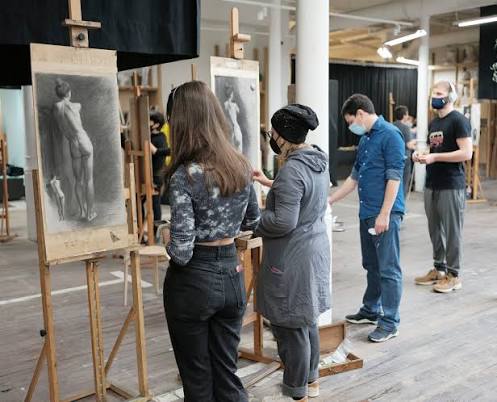
When I was an art student, we used to spend weeks doing really big charcoal drawings. Even with soft charcoal, you can't go too dark too quickly - you risk beating up the paper, and being able to make changes afterwards. So you layer it up. The closer you get to a finish, the darker you push it.
Now and again, someone's drawing would fall from the easel and come crashing down to the ground - and the impact would send all the charcoal flying off, throwing up countless hours of work into the air.
The thing is, you can spray fixative onto the surface, trapping the charcoal down and keeping it safe. There's a huge temptation to do that. If you've developed the reflex of pressing ctrl+s every 10 seconds to keep saving your work, you'll be able to relate to that - but in drawing, it's a no go.
That's because you don't know where the path will take you. As a kid, what did you want to be when you grew up? I wanted to work in film from a very young age - but almost every step of the journey was totally unexpected, and when I reached the goal, it looked and felt completely different to what I'd imagined.
Creating art is the same - nothing is over until it's done, and however much you plan, you can't predict the journey.
If you're filmmaking on a budget, my recommendation is to prep until your eyes bleed. Storyboards, rehearsals, test shoots, whatever moves you forward. But at some point, you've got to get the thing made - and the most efficient process is to march forwards relentlessly, spraying fixative at every stage.
Professional production strives for that. There are normally several “locks”, which is where a certain department promises not to change anything. “Edit lock” is the most precious, since if the edit isn't going to change, then all the post-production guys = SFX, VFX, composers, colorists, can get moving knowing that their work will make it to the screen.
The problem is that that process is efficient, but it doesn't follow one of the basic rules of the creative process - the further you get to the finish line, the more obvious your errors become. As always, art mirrors life in that regard, BUT in art, unlike in life, you get to go back and change stuff. That's a privilege that you should fixate yourself out of. Move forwards, see what's not working, go back and change it. Repeat as necessary.
And this takes us to one of the hardest things to accomplish in film, because of its complexity - how to move without friction. This is hard to do when you're just one person, and an absolute nightmare as a team, but if you're going to be going backwards as well as forwards, every tiny squeak of friction will add up and slow you down.
Companies invest millions into smooth pipelines for precisely this reason, but assuming you don't have millions, here's a list of things that you can do right now:
1. Write down your working process. How do you go from idea to finished product? If you don't have a process, you're going to have chaos.
2. Find one thing that you can do to improve it. Maybe a repetitive task that you can find a tool or use AI to solve? Maybe something that costs you a lot of time but doesn't really help? Over time, mini wins add up to massively reduce friction
3. Don't accept time wasting, be proactive about solutions. Computer running too slow? Make the files lower res, make the geometry simpler, whatever it is, do something. Most people waste their energy getting angry at the computer. It's difficult to think of many things more stupid than that