
A huge part of lighting is using it as a storytelling tool - “Painting with light”, as they say. We’ll talk about that a lot, but not right now.
Now we’re talking about the physics of light. Boo, boring, rubbish you might say. Yeah? I MIGHT SAY THE SAME ABOUT YOU.
Understanding the basic physics of light is really important. Firstly, you’ll start to realise why cinema lights are so damn big, so damn expensive, and so damn hot.
Secondly, you’ll be able to recreate light accurately in 3D (where the lights are at least free)
Inverse Square What?
Move a light twice as far from a subject and you don't get half the brightness, you get a quarter. Basically light drops off really quickly. If your renders don’t account for this, your light isn’t going to feel real.
Why The Sun Breaks The Rule
Walk ten metres away from a lamp and you'll notice the drop. Walk ten metres in daylight and nothing changes, because you're already 150 million kilometres from the source. That's why sunlight behaves like parallel rays instead of a point falling off. This is very difficult to recreate with man made light - our lights have divergent rays and fall off really quickly. So to simulate sunlight accurately, you need the biggest, most powerful light that you can afford (or, you know…go outside and use the actual sun)
Blue Sky, Yellow Sun, And Your Comp
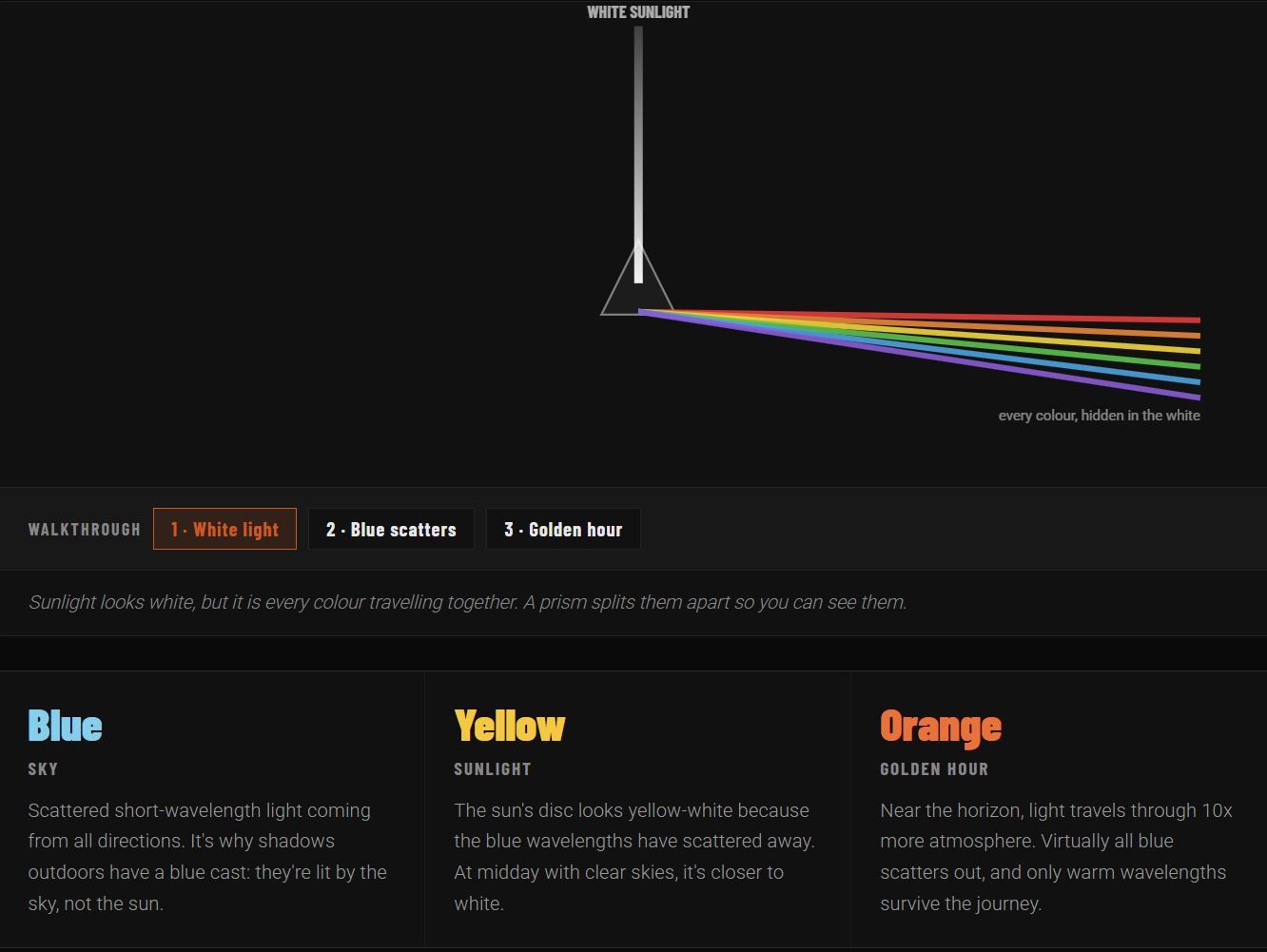
The sky is blue and the sun is yellow for the same reason: shorter wavelengths scatter more easily through the atmosphere. That scattering is also why shadows outdoors read blue and why golden hour tips everything warm as the sun's light travels through more atmosphere at a lower angle. If you’re shooting outside, you’re always “chasing the light”, but understanding the light will help you match the shots in post.
Here’s a cheat sheet to help you get to grips with it, which also gets into the technical details of the pros and cons of different lights that you can hire on set, and how much they’d cost
 >
>