
Jul 16
/
Christian Bull
LINES OF ACTION
AN INVISIBLE LINE - CROSS IT WITH CAUTION
The line of action, or 180 degree rule, is filmmaking 101. It’s simple stuff - in many film scenes, you will be able to define a“line of action”, which is literally an invisible line between the main elements of your scene. The classic example is two people talking to each other. As long as the camera always stays on one side of the line, you’ll have one person on the left of screen, and one person on the right.
Cross it by accident and your actors swap sides of the screen mid-conversation. It’s jarring to a human eye, because it makes you feel like either they just teleported, or you the viewer did.
If you cross the line in a car chase, the cars suddenly change direction and chase each other the other way.
Empty space, drag to resize
WHO CARES?
I wasn’t sure whether to talk about this concept, because it’s the kind of thing film students learn in their first week and then hold onto a rule. But when you actually study film, you’ll see the line getting crossed everywhere.
So it’s not a rule. It’s just a thing. There’s a certain feeling when you cross it. Do you want that feeling or not? Frenetic John Woo style shootouts jump over the line constantly, it’s perfect for capturing the chaotic feeling of being in a fight and not knowing exactly where anyone is or where the bullets are coming from.
Empty space, drag to resize
HOW TO CROSS IT GENTLY
If you need the camera on the other side of the line, but you don’t want the visual jump that happens from crossing it, you can do a two-step over the line - basically cutting to something else, and then cutting to the other side of the line.
In a conversation, you can cut to a front on shot of one of the people talking. That’s your first step, you’re right on the line. Then the next step crosses over the line, and it’ll be smooth as silk.
In car chases, a front-on shot of the car does exactly the same thing.
Cutaways help too, this is why you always want to shoot B-roll on set - in a cafe chat, a close up of a hand grabbing a coffee will help, or a pedestrian's reaction to a car zooming past will give you that extra step in a car chase.
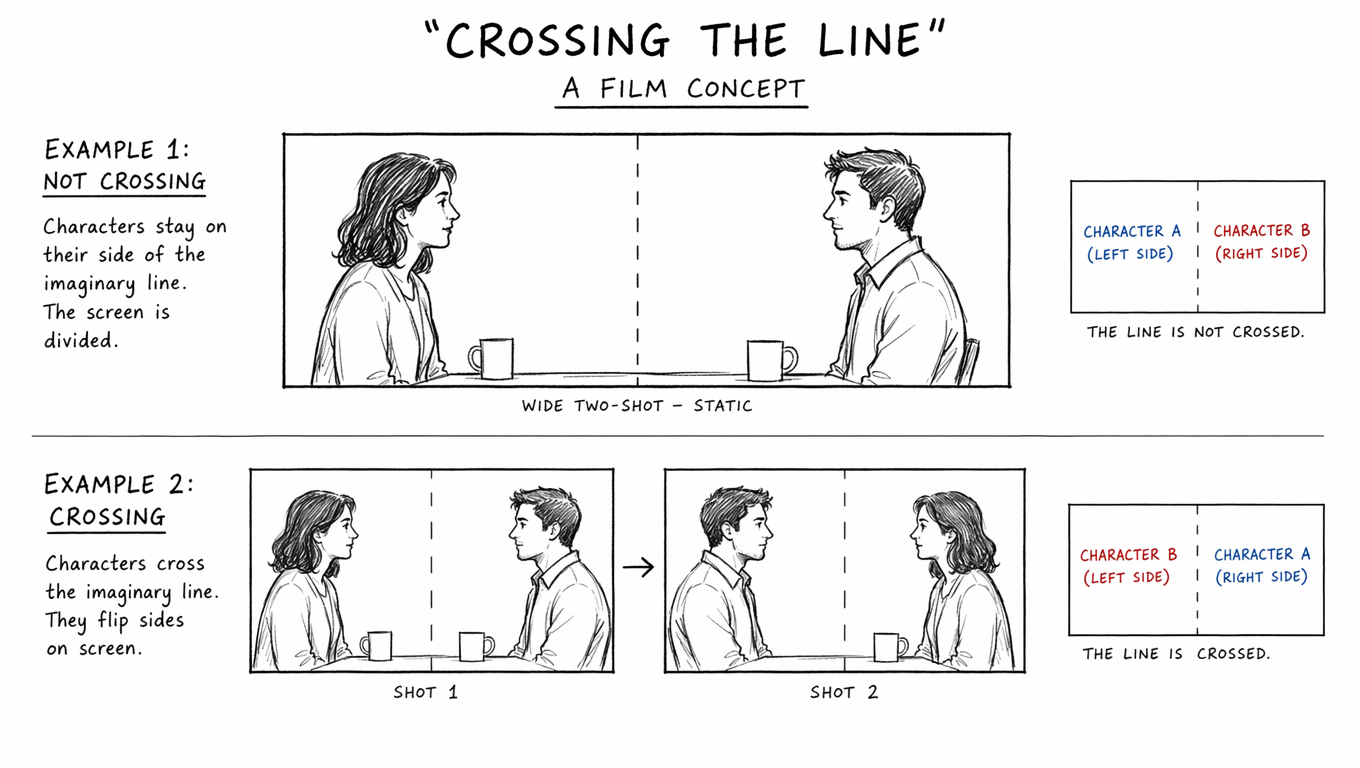
The above image shows the problem, but if you want to feel it, hold your feels no longer! Our cheat sheet has a 3D scene that lets you move the cameras wherever you want and see the impact of the cut
Empty space, drag to resize
Empty space, drag to resize
Empty space, drag to resize
Write your awesome label here.
Write your awesome label here.
Write your awesome label here.
Write your awesome label here.
Success! You're all signed up to the follow along!
Keep an eye on your email for updates and reminders
Write your awesome label here.
Write your awesome label here.
Write your awesome label here.
How do you want to make your film?
Close
Claim your 20% off
Thank you!