
Jul 14 / Christian Bull

Mastering the Visual Spectrum: 🌈

Munsell's Color Wizardry for Filmmakers & VFX Artists!

Have you ever wanted to unravel the mysteries of color and learn how to harness its power for film and VFX? Look no further than the Munsell color system! This ingenious system dissects color into three distinct components that will revolutionize your creative endeavors.


For years, artists refer to different colors by name, which of course we still do. And if you buy paints today, you’ll find many different names for red or blue or whatever. But Munson gave us a language to describe any color. He did this by breaking color into three different components.

Hue
Firstly, there’s hue - essentially, the “what” of color. Is it blue, red, purple, or yellow? When we describe a colour in day-to-day conversation, we’re generally referring to its hue.

Chroma
Next, we delve into chroma, which encapsulates the purity or intensity of a color. Picture it as the color’s vitality and vibrancy. Most people use the word saturation for this and that’s ok. Technically they’re different - chroma refers to the true color of an object and saturation refers to how it appears lit in an environment. But use whatever tickles your pickle, so long as you’re learning about colour!

Value
Lastly, but most certainly not leastly, there’s value. Quite simply, the lightness or darkness of a color!

If you add white, you increase the value and the color gets lighter. If you add black, you decrease the value, and the color gets darker.

Every single color in the world can be precisely described through hue, chroma, and value.
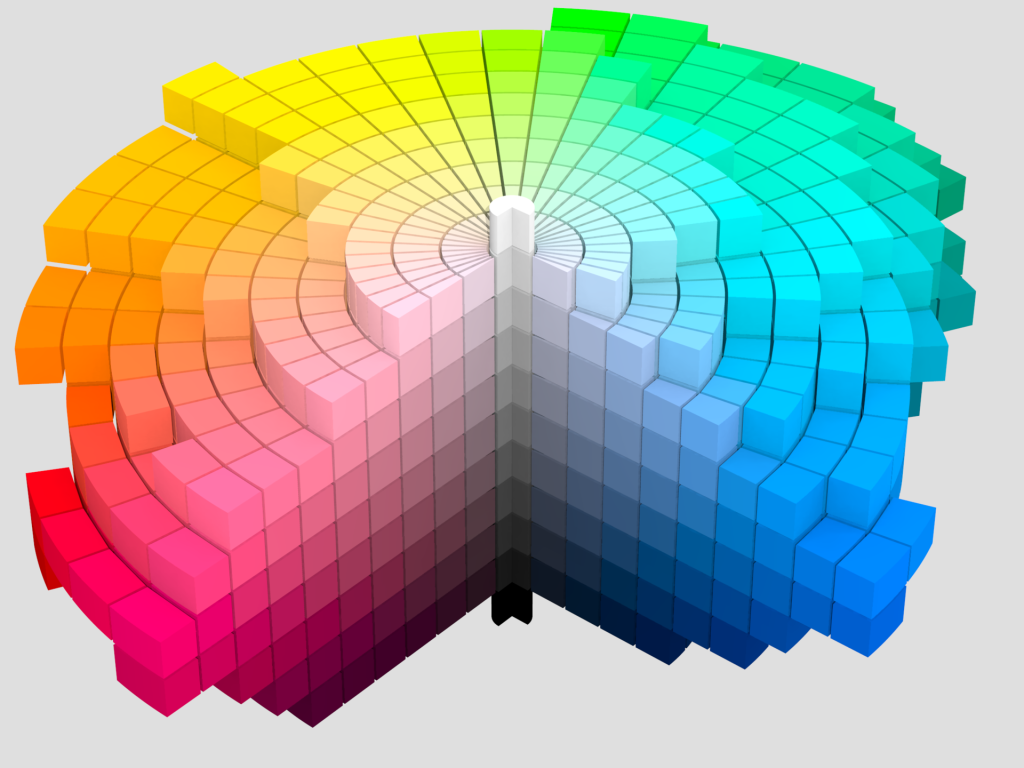
The Munsell Colour “tree”. Value is at the core, hue is the changing colour around the circumference, and chroma is the distance from the outside to the core


Not TOO complex, right? Good! So…


WHERE to use the Munsell Color System in your work

The Munsell Color system has a profound impact on various facets of film and visual production. I use it whenever I’m trying to match the color from two different things, which is…pretty much ALL the time!
In compositing, you’re constantly trying to get things to match, and when you’re working with lighting in 3D, you’re always trying to match something that was filmed in real life. Colorists will have to match shots to get them to sit seamlessly together in the edit. The need to understand colour permeates nearly all film departments. And Munsell is your secret weapon!

HOW to use the Munsell Color System in your work

So, how do you unlock the full potential of this remarkable system? It’s simple - divide and conquer! Start by stripping away the colors and focusing solely on value. Matching grayscale values is a crucial first step that sets the foundation for your color mastery. Value holds the key.

The colours are beautiful, but to really see what’s going on, you need to remove them! See how the orange area isn’t actually much brighter than the surrounding blue sky? You’ll hit surprises like that all the time!


So that’s it. Make your work grayscale and focus on the values, then focus on the hue, then you’re done. Repeat 100 times or 1000 times, and you’re a master of color! This is the exact process that I teach to my artists, and I recommend that you give it a try!