
The most important question you’re probably not asking
The key to moving your film from your head to the real world
Every film is a fresh batch of problems
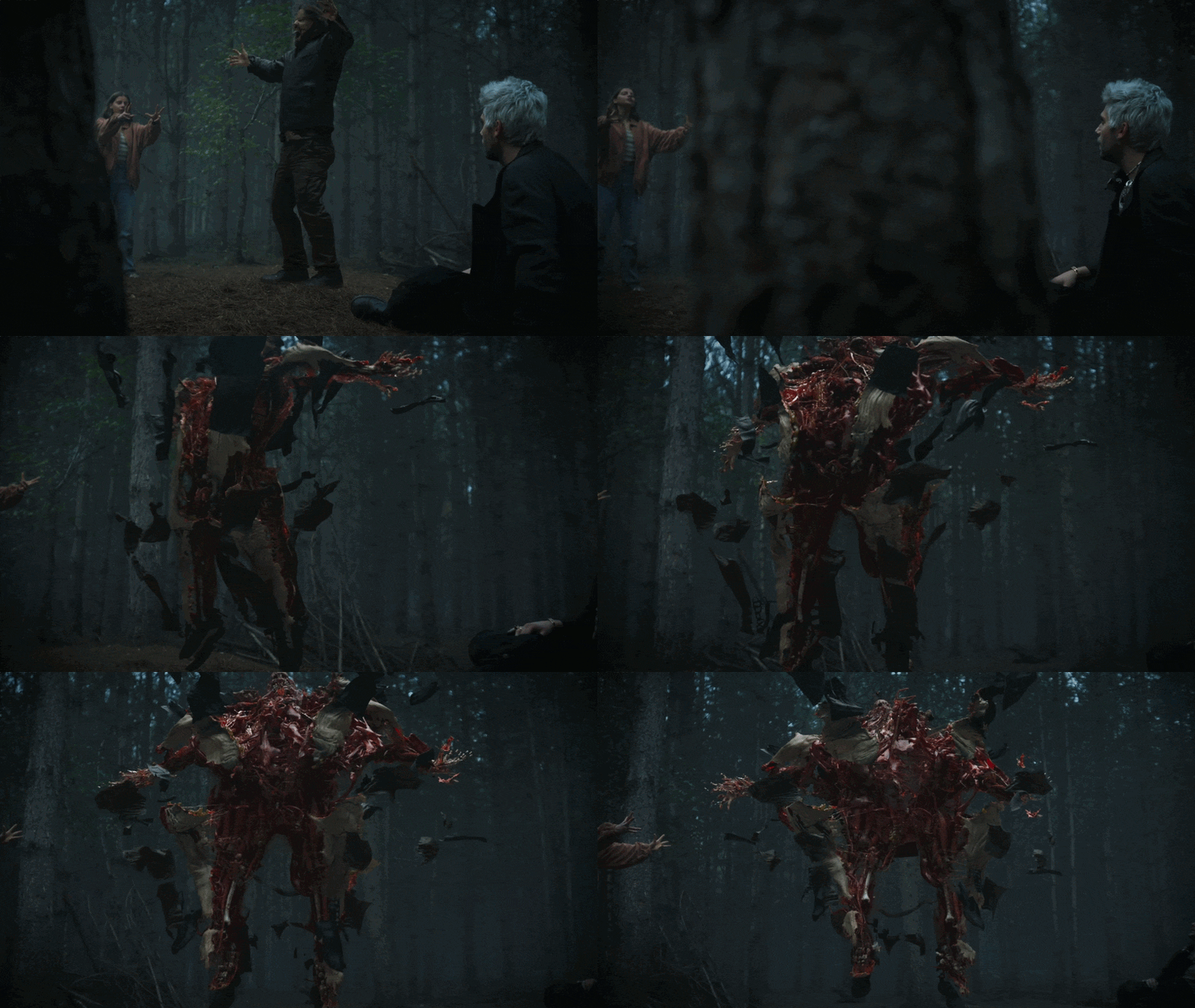
Shoot First Team's work on Netflix Series: "Half Bad: The Bastard Son and The Devil Himself"
A headache for me and my team, but much worse for this guy.
The assumption that “there’s always a way” is optimistic, but it’s correct. As someone working with film, you have to believe that every problem is solvable, because every day is a fresh new batch of problems.
Definitely do be optimistic, but don’t believe in magic (at least not in your filmmaking). “Movie magic” is in the audience’s reaction to your work. The actual process should be grounded in the real world.
Before you start, answer these questions
- What are you going to do, and by when?
- What’s the budget?
- What’s the reason?
- What skills do you and your team have?
A framework for tackling the unknown
Step 1: Honestly assess your experience
Have you ever done something like this before? If the answer is “no”, assume it will be significantly harder than you think, but don’t let that stop you moving forward. It just means you have to find a way to sprint to get the knowledge as to exactly how much harder it’s going to be.
Step 2: Use pre-production to gather data
You’re going to have to work out what is the smallest amount of work that you can put in to get the maximum amount of data to inform you how you’re going to tackle this.
Step 3: Put something in the frame
That’s generally going to be just storyboarding or filming something, anything, that even loosely represents a section of what you’re going for. Storyboard is a scary word for people with no drawing experience, but stick figures are fine. You will learn a lot as you transition from the infinite space of your mind to the limited space of the frame.

Scorsese’s own storyboards from Taxi Driver. Who cares if it’s not a pretty drawing? It’s just there to get data.
Example 1
Your film is set on a spaceship: first time using green screen
According to the steps above, the question isn’t “how hard is chroma keying”, it’s “have you done it before?” Because if the answer is “no”, expect it to be a lot harder than you expect.
Then get some green cloth, get your phone, and film 2 shots. Something like this is going to happen: you’ll instinctively move the camera, and then realise that even if the chroma keying part IS simple, if the real camera moves, you need your digital camera to move in the same way. And that’s when you realise you need to learn about camera tracking. The way you’ve learned that is SO much better than me telling it to you, and of course SO much better than having your shoot done and realising the shots can’t be tracked.
Example 2
You want to make an AI feature film
Storyboard just one scene that you know will be complex, because it requires nuanced acting, a big monster beat, or very directed camera work, and start generating the shots.
You’re going to hit all the limitations of AI generated footage really quickly, as well as getting key information on cost (how much did you spend just on that one scene?). Then you can revisit your plan and see if it makes sense. It might do, or it might not. That’s not the point. The point is that you took the step from dreaming about it to doing it, but in a contained and manageable way. And THAT’S THE PROCESS.
Not currently a Shoot First student and want access to these videos along with all other filmmaking and vfx tutorials?
Success! You're all signed up to the follow along!
How do you want to make your film?
Close
Claim your 20% off