
Lines of Tension
Every frame has an invisible elastic band connecting its key points. The closer they are, the more it sags. The further apart, the more it pulls taut. That tension tells the story before a word is spoken.
The Elastic Band
Imagine stretching a rubber band between two people in your frame. When you pull them apart, the band goes straight and tight. When they move close, it sags and curves. That visual tension is felt by the audience instantly, before they've consciously processed anything.
Subtext Without Words
The tension between two characters physically expresses their relationship: threat, longing, power, standoff. A taut line creates urgency and danger. A sagging line can show closeness, comfort, or the danger of proximity. The frame itself is speaking.
Stretch, Then Breathe
The further apart your key points, and the more they push toward opposite edges of the frame, the greater the tension. Stretch the band as much as your story needs, then let it breathe.
What Changes the Tension?
Distance: further apart = tighter band, more drama. Angle: a diagonal line is more alive than a horizontal one. Frame size: the same distance feels different in a wide vs. a tight format. Depth (Z-axis): one character pushed back in space cuts the band through the camera's axis rather than across it. Frame edges: the closer a character gets to the edge, the more the line is compressed against it, increasing intensity on that side.
Elastic Band Simulator
Drag A and B apart to feel the tension build. Use the depth sliders to push a character close to camera or deep into the background, and watch the line run through the frame.
Putting It To Work
Six ways to use the elastic band on set. Each takes the same underlying principle and points it at a different storytelling problem.
Place characters at opposite thirds of a wide frame. The taut diagonal line between their eyelines creates a maximum tension standoff. Used in Westerns for a reason.
When two characters are very close, the band sags, but closeness to the frame edge creates its own pressure. An intimate frame can feel trapped and threatening.
Push one character deep into the frame. The tension now runs through the camera, toward and away from the lens. The larger foreground character dominates.
The same two characters in a vertical frame feel more intense than in a wide one. Format amplifies or softens tension. Feel the difference as you reframe.
A diagonal line of tension is more alive than a flat horizontal. It creates imbalance, movement, urgency. Tilt the relationship and the frame comes alive.
Add an object, window, or environmental element as a third key point and you create a triangle of tensions, a layered composition that rewards the audience's eye.
Reference Stills
Three frames, three uses of the elastic band. Look at where each line runs and how much it's stretched, then watch for the same shapes in everything you shoot.
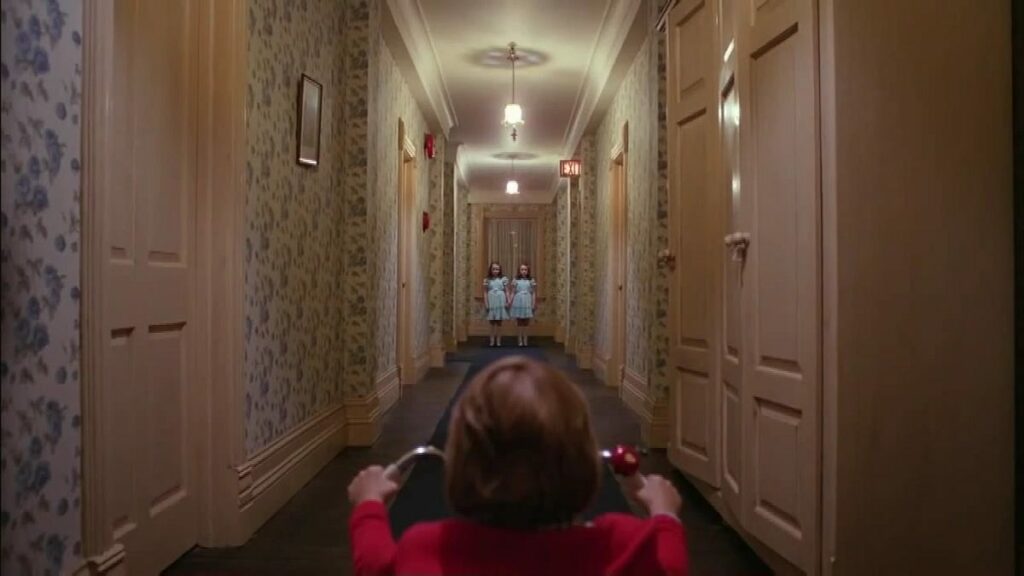
The band runs straight down the corridor, away from the lens. Foreground and background are pulled as far apart as the frame allows. The line is taut through the camera, and the depth is the threat.
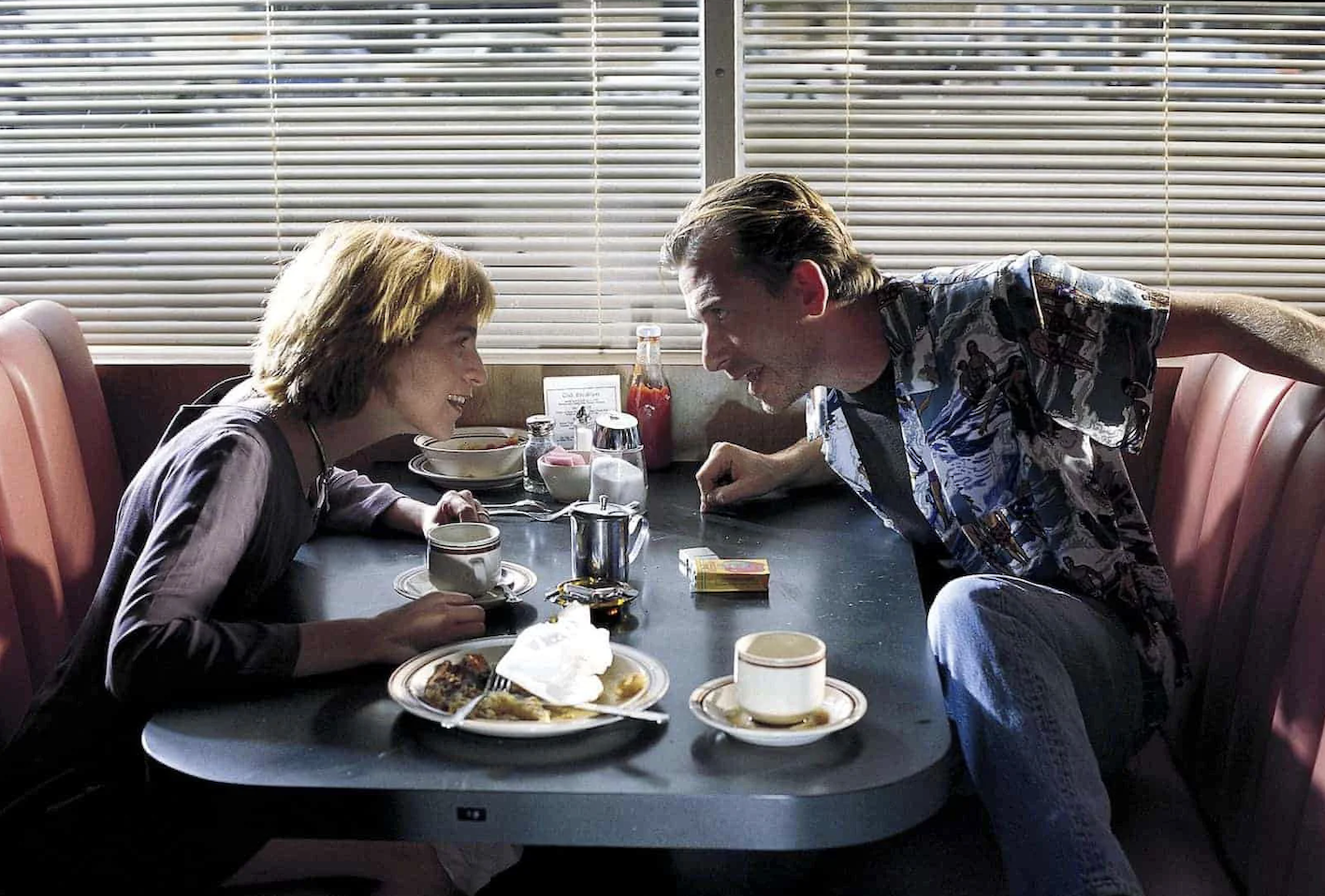
The two key points sit close together, so the band sags. That slack reads as closeness, leaning in, sharing the same small pocket of space across the table.

Three points spaced around a circle form a triangle of tensions. Every figure is pulled taut against the other two at once. No line is allowed to relax, and the frame holds maximum charge.