
Ask AI to light a shot cinematically, and it’ll do it pretty well, in that your brain will register it as cinematic. But what if you want to do that yourself? What does cinematic even mean?
Honestly, it’s probably the wrong thing to aim for. I would recommend just going “How would the light actually look in this shot?”, and starting with that as a base.
Then after that it’s just the basic design/storytelling:
- Where do you want the audience to look, and why? How do you get them to look there?
- Is there anything that will distract them, and make them look elsewhere? If so, find a way to remove it.
- How should they feel when looking where they’re looking?
- What one purpose does that shot serve?
Any “rules” of cinematography should only be used to serve that purpose.
Shoot from the Shadows
For example, here’s a rule that will be really useful if you use it – “shoot from the shadows”. What does that mean? Well, basically you want your subject between your camera and the light source.
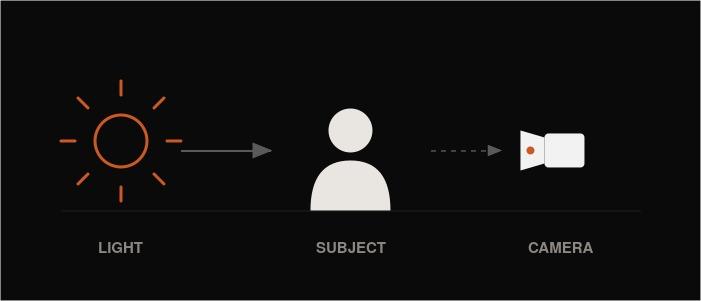
Because then you will have contrast in your shot. Why is contrast good? It separates your subject from your background. Why is that good? If your subject bleeds into the background visually, your eye doesn’t know where to look, so your shot is unfocused.
Good and Bad Only Exist in Context
So why don’t influencers do that? They have ring lights right behind the camera, so they’re going:
Light → Camera → Subject
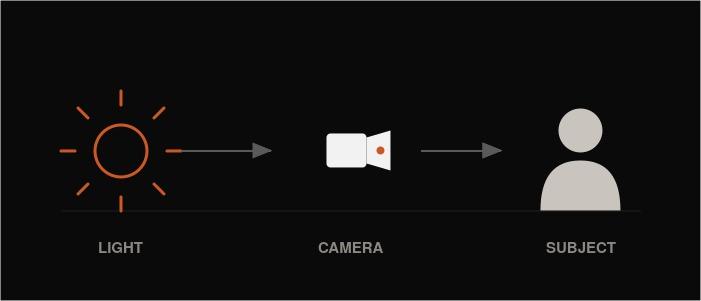
Which totally flattens them out. THAT’S WHAT THEY WANT. When it comes to looking nice for Instagram, flat is “good”, since noticeable jumps in shape (eyebags, moles, crooked nose) are seen as “less good”. In cinema, flat is “boring” because it removes description. But “boring” might be right for the shot – maybe you’re cutting to something really sculpted, and you want the juxtaposition.
Good/Bad only exists in the context of what your shot needs to achieve, BUT without some basic guidelines it can be difficult to know HOW to light your shot to tell the story that you want.
The Cheat Sheet
That’s where this cheat sheet comes in. It’s designed to get you up to speed with cinematography 101, and covers:
- Shooting from the shadows
- Source size and softness
- Fill ratio and mood
- Inverse square falloff
- Focal length and perspective
- Camera height as status
- Depth layering
- Highlight clipping
- Common lighting setups (three point, single source, key and bounce, back light only, top light)